
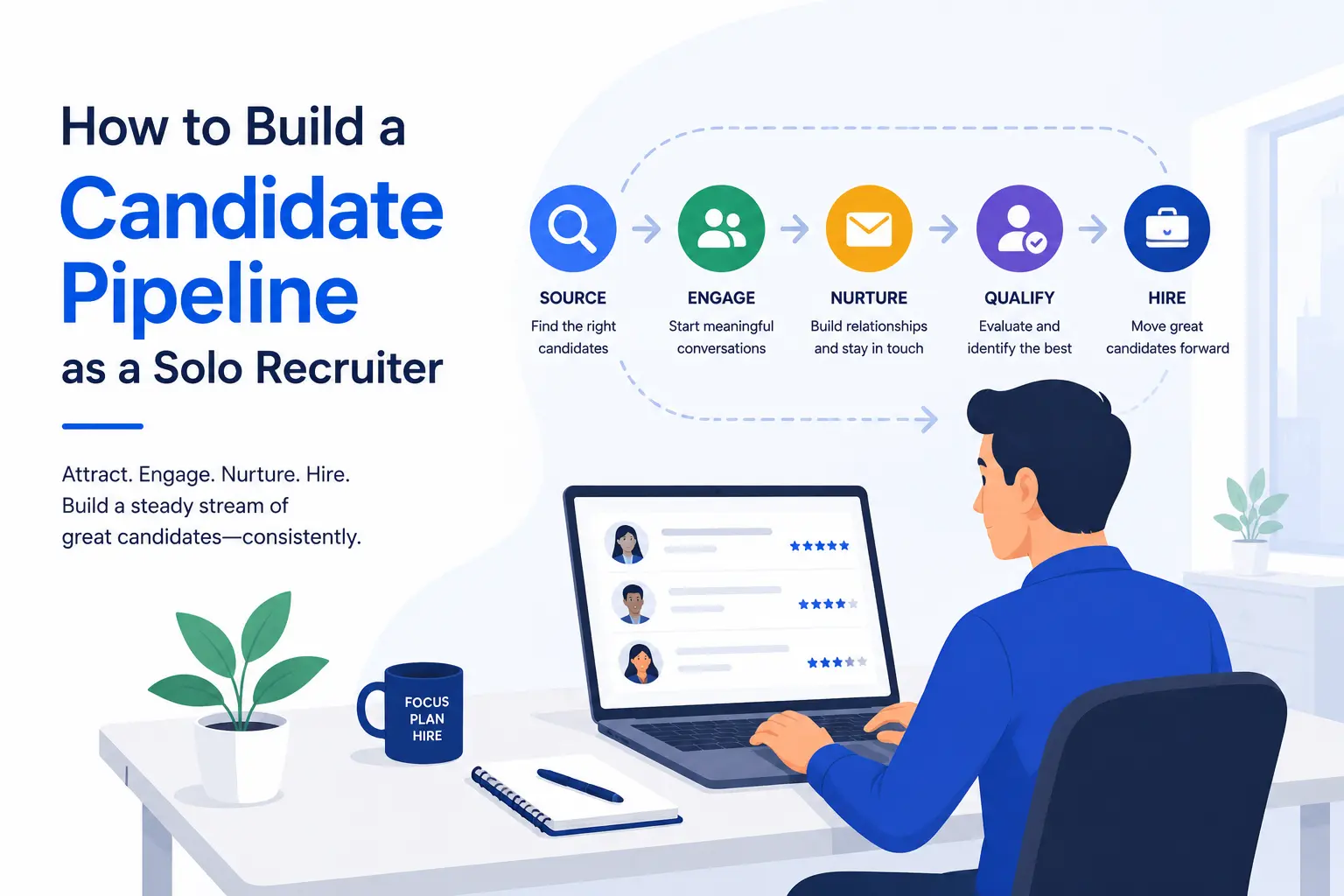
56% of recruiting leaders identify talent shortages as their biggest challenge.
Most hiring pipeline advice assumes you have a team. There's a sourcer, a coordinator, maybe a recruiter for each business unit. When that's your reality, candidate pipeline development is a coordinated effort with shared accountability. When you're the only recruiter, none of that applies.
You're sourcing, screening, scheduling, and closing across multiple open roles at once. When a candidate drops at the offer stage, there's no one to absorb the fallout with you. So advice aimed at recruiting teams, while not useless, misses a lot of what makes solo pipeline management actually work. This guide explains how to build a candidate pipeline as a solo recruiter.
The Pipeline Coverage Ratio (And Why Most Guides Skip It)
A pipeline coverage ratio tells you how many engaged candidates you need per open seat to reliably make a hire. The formula is: divide your pipeline volume by your hiring target.
The right ratio depends on your conversion rate. If you hire one in four people you interview, you need a ratio of at least 4. Here's a rough guide by role type:
|
Role Type |
Minimum Ratio |
Recommended Ratio |
|
Entry level |
2x |
3x |
|
Technical / mid-level |
3x |
4x |
|
Senior / leadership |
4x |
5x |
|
Executive |
5x |
6x |
If your ratio drops below 2 for any active role, either your sourcing volume is too low or candidates are falling out faster than new ones are coming in.
Where to Source When You Have Limited Time
Solo recruiters tend to be everywhere and effective nowhere when it comes to sourcing channels. Depth in two or three channels beats shallow presence across ten.
Direct Outreach
Direct outreach is five times more likely to result in a hire than waiting for inbound applications. If you have limited time, that single data point should shape how you allocate it.
Employee Referrals
Referrals are chronically underused because the asks are too vague. "Let me know if you know anyone" gets you nothing. "I'm looking for a senior backend engineer this quarter, specifically someone strong in Go who's worked at a company that's scaled fast. Who in your network fits that?" gets you something to work with. The more specific the ask, the better the referral quality.
Your Existing ATS
Candidates who interviewed well 18 months ago and weren't hired due to timing, competition, or a headcount freeze are almost always overlooked. A 30-minute weekly pass through past candidates frequently surfaces people worth recontacting. They already know your company, which shortens the warm-up process considerably.
The challenge is that most solo recruiters don't have a clean place to search these people. If you're using a tool like CANSPLA, every application you've ever received lives in a single searchable resume database across all your job posts. You can filter by skill, location, or labels like "Previously Shortlisted" and pull up relevant past candidates in seconds, without digging through email threads or old spreadsheets.
How to Build a Candidate Pipeline Without Overcomplicating It
A six-stage recruitment pipeline covers most of what you need:
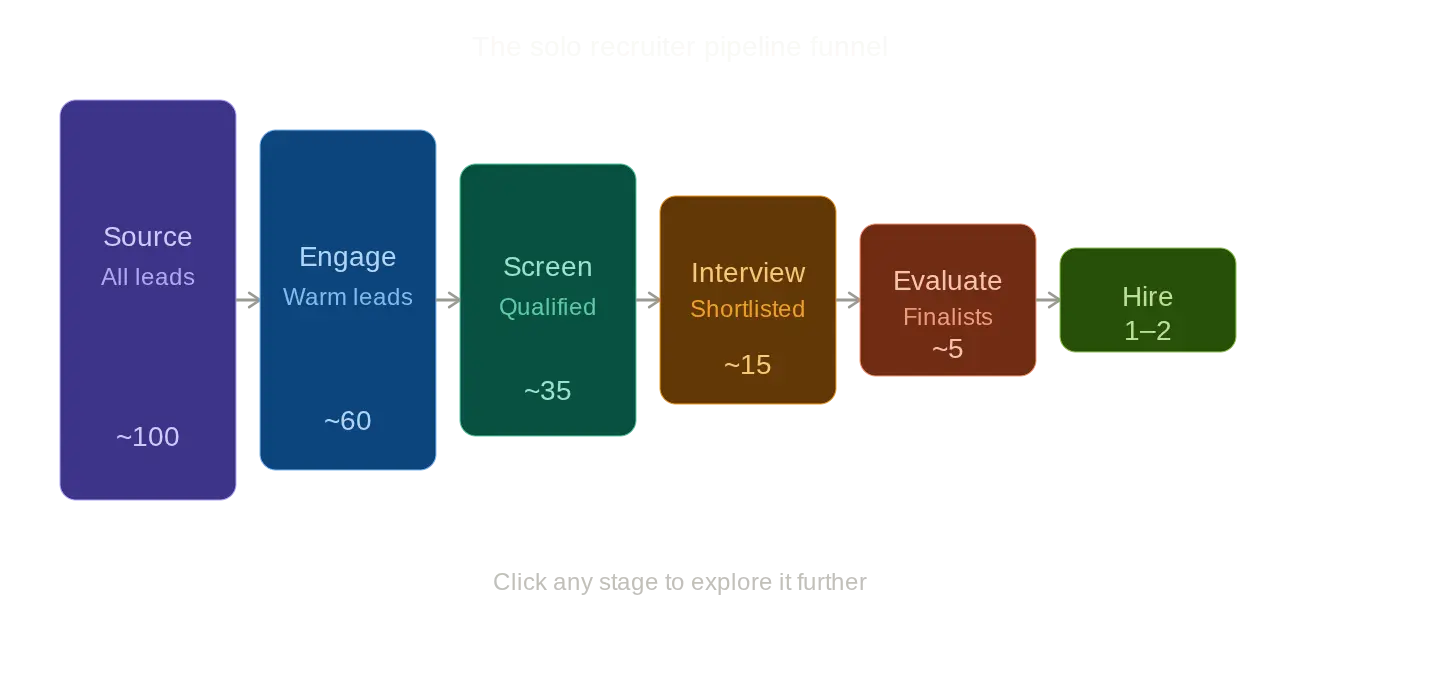
Research from Dover's recruiter practice recommends capping pipeline stages at 12. For solo recruiters, 6 is the practical ceiling before the system becomes harder to manage than keeping notes in a spreadsheet.
The One Discipline That Actually Matters
Move candidates through stages consistently. Someone sitting at the same stage for two weeks is effectively cold, regardless of how interested they seemed initially. A recruiting pipeline full of stale candidates is just a database. It won't help you when a role opens urgently.
Also worth knowing: 77% of candidates who have a poor experience during recruiting will share it with others. For a solo recruiter without the brand presence to absorb reputational costs easily, being fast, honest, and communicative throughout the process directly affects whether strong candidates recommend your company to people in their network.
CANSPLA is set up for exactly this workflow: you can move candidates through stages, add notes, and apply labels from a single profile view, which keeps the overhead low enough that you'll actually use it consistently.
Writing Job Descriptions That Filter Before You Have To
A job description written to attract maximum volume creates maximum work for the person doing the screening. When that person is only you, it's a problem worth solving at the source.
What Most Job Descriptions Leave Out
A salary range: Posting compensation filters out candidates who'll decline on money anyway.
An honest description of the environment: Being upfront about pace, autonomy expectations, or team maturity attracts candidates who've self-selected for that kind of environment.
Realistic requirements: Long lists of requirements produce worse applications, not better ones. Strong candidates, particularly those from underrepresented backgrounds, are less likely to apply when they don't meet every item. Write requirements that reflect what's genuinely needed in the first 90 days, not every skill that might conceivably be useful at some point.
Keeping the Pipeline Warm Over Time
Building a talent pipeline and keeping it warm are different activities, and most of the failure happens in the second one.
-
Top pipeline candidates: A check-in every four to six weeks. Share something relevant, ask a genuine question about where they're at, and keep it brief.
-
Secondary candidates: Quarterly contact. A relevant article, a company update, or a short note is usually enough to maintain the relationship without consuming much time.
-
"Not ready yet" candidates: Tag them in your ATS with a recontact date so they don't silently age out of your pipeline.
Protecting Pipeline Time Before It Disappears
Solo recruiter pipelines usually break down because active hiring takes over the entire week, pushing pipeline-building aside until there’s “free time” that never comes.
The solution is simple: protect sourcing and nurturing time in your calendar before anything else gets scheduled.
|
Day |
Activity |
Time |
|
Monday + Tuesday morning |
Sourcing |
30% of recruiting time |
|
Tuesday afternoon |
Outreach and nurture |
20% |
|
Wednesday |
Screening calls |
25% |
|
Thursday morning |
Interviews |
15% |
|
Friday half-day |
Admin, ATS updates, review |
10% |
Conclusion
Talent pipeline development without the right infrastructure is like trying to run a CRM in your email inbox. It works until it doesn't, and when it breaks down it usually does so quietly.
CANSPLA is built with independent and small-team recruiters in mind. It brings candidate management, sourcing tracking, and pipeline visibility into one place without the configuration overhead that comes with enterprise platforms designed for large teams. Each application received on a job post builds your personal candidate database, scored by match percentage and organized by role, so your pipeline compounds over time rather than resetting with every new hire.
For solo recruiters maintaining multiple pipelines simultaneously, the practical value is less time spent managing the system and more time spent recruiting. It's worth evaluating as part of your core setup.
Frequently Asked Questions
How many candidates should be in my pipeline at any given time?
Aim for 3 to 5 engaged candidates per open role at the screening or interview stage, plus a broader sourced group sitting at the top of the funnel.
What is the biggest pipeline mistake solo recruiters make?
Building a big list and then never contacting anyone on it, because a pipeline with no active relationships is just a spreadsheet.
How do I build a pipeline for executive roles when I don't have those networks?
Ask your existing leadership team who they respect in their field and get them to make a warm introduction, since that one tactic will outperform any amount of cold outreach.
Should every open role have a talent pipeline?
No. Pipelines work best for roles that appear regularly, are difficult to fill, or create operational issues when left vacant.